Elbert County Dog Registration Information
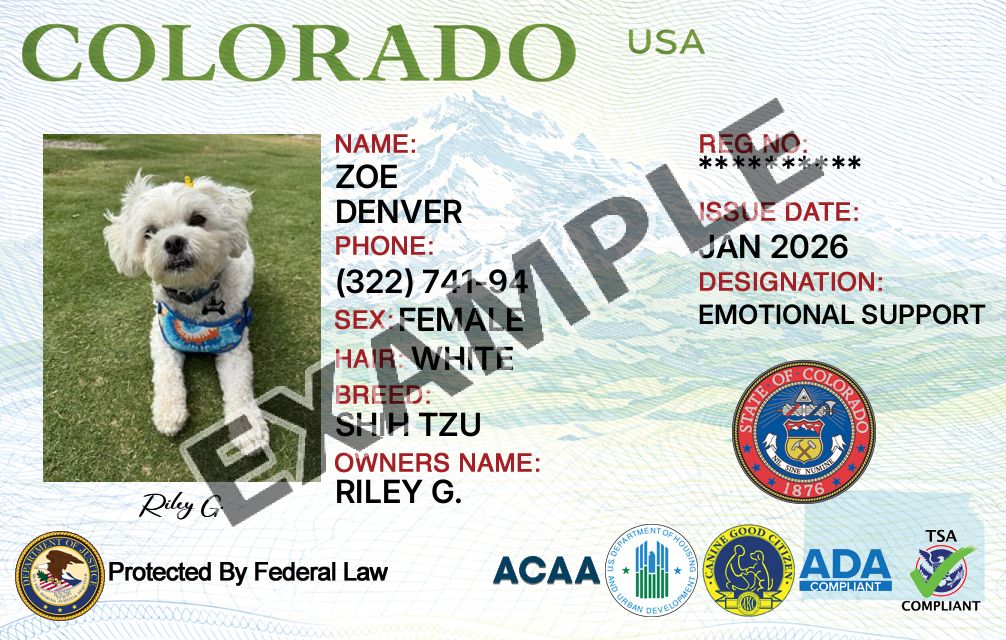
Service Dogs and Emotional Support Animals in Elbert, Colorado
If you’re searching for where to register a dog in Elbert County, Colorado—especially for a service dog or an emotional support animal (ESA)—the key is understanding that “registration” can mean two different things: (1) local dog licensing (a county or town requirement tied to rabies vaccination and identification), and (2) the legal status of a service dog or ESA, which is not handled through a single universal federal registry. This page explains how dog licensing requirements in Elbert County, Colorado generally work, which local offices to contact, and what steps to take depending on whether you live in unincorporated Elbert County or inside a town such as Elizabeth.
Where to Register or License Your Dog in Elbert County, Colorado
The best starting point for an animal control dog license in Elbert County, Colorado depends on where you live:
Unincorporated Elbert County: Contact the Elbert County Sheriff’s Office (the county’s primary law enforcement agency, which also serves as a practical starting point for county-level animal control questions and direction).
Within the Town of Elizabeth limits: The Town Clerk’s office manages dog licensing for town residents.
Elbert County Sheriff’s Office
Note: The Sheriff’s Office contact details above are official county contact information. If your question is specifically about dog licensing forms/tags or animal control coverage, ask to be directed to the appropriate county process or staff for your address in Elbert County.
Town of Elizabeth — Town Clerk (Animal Licensing)
If you are not sure whether your home is inside Town of Elizabeth limits or in unincorporated Elbert County, ask the Town Clerk (or the county) to confirm jurisdiction for dog licensing based on your address.
Overview of Dog Licensing in Elbert County, Colorado
Dog licensing vs. “registering” a service dog or ESA
When people ask, “where do I register my dog in Elbert County, Colorado for my service dog or emotional support dog,” they’re usually trying to accomplish one (or more) of these goals:
- Comply with a local dog license requirement (often city/town-based, and sometimes county-based depending on ordinances and enforcement).
- Show proof of rabies vaccination and obtain a tag or documentation.
- Confirm the dog’s status as a service dog or emotional support animal for housing, work, or public-access questions.
Local licensing is about the dog living in a specific area. Service dog and ESA status is about what the dog does (service dog) or what the dog supports (ESA) and which law applies (ADA vs. FHA). These are separate concepts, and they are handled differently.
County-wide vs. town-based rules
Elbert County includes incorporated towns and large unincorporated areas. In many Colorado communities, towns/cities require dog licensing for dogs living within town limits, while unincorporated county rules can differ. That means you may be dealing with:
- A town licensing office (example: Town of Elizabeth Town Clerk) if your address is inside town limits.
- County direction (often through the Sheriff’s Office or county administration) if your address is in unincorporated Elbert County.
What You Need Before Registering a Dog
Common documents and details
While exact requirements can vary by jurisdiction, most dog licensing requirements in Elbert County, Colorado-area agencies follow a familiar pattern. Before you apply, plan to gather:
- Rabies vaccination certificate from a licensed veterinarian showing the vaccination is current.
- Dog description (breed, color/markings, approximate age, sex).
- Owner contact information (name, physical address, phone, email if requested).
- Spay/neuter documentation (if your jurisdiction sets different fees for altered vs. unaltered dogs).
- Payment method accepted by the licensing office.
Rabies vaccination and local licensing
In Colorado, local licensing and animal control rules commonly require proof of rabies vaccination before a license or registration permit is issued. This is a public health and identification issue: it helps confirm vaccination status and helps return lost dogs to their owners.
Steps to Register or License a Dog in Elbert County, Colorado
Step 1: Confirm your jurisdiction (town vs. unincorporated county)
Start by confirming whether your dog is primarily housed:
- Inside Town of Elizabeth limits: Use the Town Clerk’s animal licensing process (see office details above).
- Outside town limits (unincorporated Elbert County): Contact the Elbert County Sheriff’s Office to ask which county process or animal services contact handles licensing questions for your address.
Step 2: Prepare proof of rabies vaccination
Most licensing systems will require the rabies certificate details (date administered and expiration). If your dog is newly vaccinated, ask your veterinarian for a copy of the rabies certificate you can submit.
Step 3: Submit your application and pay the fee (if applicable)
If you are within a town that requires licensing, you will typically submit an application (online, email, or in person depending on the town) along with rabies proof and any spay/neuter proof, then pay the licensing fee. For example, the Town of Elizabeth states that it will not issue a license without proof of current rabies vaccination.
Step 4: Keep your license/tag information accessible
After approval, you may receive a license tag number and/or a physical tag. Keep the receipt and rabies certificate with your household records. Many owners also keep a copy on their phone for quick reference if needed.
Service Dog Laws in Elbert County, Colorado
Service dogs: legal status (not a registry)
A service dog is generally a dog that is individually trained to do work or perform tasks for a person with a disability. The dog’s legal status comes from the dog’s training and function, not from being listed in a database.
- No single universal federal registration is required to have a legitimate service dog.
- Businesses and public places typically focus on behavior and permitted questions (in many cases limited to whether the dog is required because of a disability and what tasks it is trained to perform).
- Local health rules can still apply (for example, vaccination requirements and local licensing requirements where applicable).
Do service dogs still need a dog license in Elbert County, Colorado?
In many jurisdictions, service dogs are still subject to local licensing (they are still dogs living in the community). However, some places may waive or reduce licensing fees for service dogs while still requiring proof of rabies vaccination and basic identification. Because these details can vary by local ordinance, the practical approach is to contact the appropriate office above based on your address and ask how they handle licensing for service dogs.
Emotional Support Animal Rules in Elbert County, Colorado
ESAs: housing-related status, not public-access status
An emotional support animal (ESA) is not the same as a service dog. ESAs are most commonly recognized in the context of housing. An ESA typically supports a person with a disability by providing emotional support, but it is not necessarily trained to perform specific tasks like a service dog.
- There is no universal federal registry that makes an ESA “official.”
- For housing requests, documentation is usually handled through a healthcare provider’s letter/process (as applicable to your situation), not through a dog licensing office.
- Even if your dog is an ESA, local dog licensing requirements in Elbert County, Colorado (town or county, depending on jurisdiction) may still apply.
Local licensing still focuses on rabies and identification
Local dog licensing is typically not an ESA verification system. It is a community identification and compliance system that commonly requires rabies vaccination proof and a licensing fee (when required by the jurisdiction).
Quick Comparison: Dog License vs. Service Dog vs. Emotional Support Animal
| Category | Dog License (Local) | Service Dog | Emotional Support Animal (ESA) |
|---|---|---|---|
| Primary purpose | Local identification and compliance (often tied to rabies vaccination and ordinances) | Performs trained tasks/work for a person with a disability | Provides emotional support related to a disability (commonly in housing context) |
| Where handled | Town/city clerk or county-designated office (varies by jurisdiction) | Legal status based on training and disability-related tasks (not a single registry) | Typically handled via healthcare documentation for housing (not a local dog licensing office) |
| Is there a universal federal registry? | No (it’s local) | No | No |
| Common documentation | Rabies vaccination certificate; owner/dog information; spay/neuter proof if relevant | Training/tasks information (not “papers”); must comply with local vaccination/health rules | Housing-related documentation (as applicable); must comply with local vaccination/health rules |
| Does local licensing still apply? | Yes | Often yes (fee waivers may exist depending on local rules) | Often yes |
Frequently Asked Questions
Do I need a dog license in Elbert County, Colorado if my dog is a service dog?
Many jurisdictions still require a local dog license for service dogs, because licensing is about local identification and vaccination compliance. If you live inside the Town of Elizabeth limits, contact the Town Clerk’s animal licensing contact listed above. If you live in unincorporated Elbert County, contact the Elbert County Sheriff’s Office to confirm the correct county process for your address.
Is there an “official” ESA registration I have to complete with the county?
Typically no. ESAs are generally addressed in housing-related contexts and are not made official by a county registry. Separately, your dog may still need a local license depending on where you live in Elbert County and the applicable municipal or county rules.
What proof is usually required to get a dog license?
Proof of current rabies vaccination is commonly required before a license can be issued. Many jurisdictions also ask for a description of the dog, owner contact information, and spay/neuter documentation if fees vary based on sterilization status.
I live near Elizabeth but I’m not sure I’m inside town limits. Who should I call?
Call the Town of Elizabeth Town Clerk for help confirming whether your address is within town limits. If it’s not, contact the Elbert County Sheriff’s Office to confirm the appropriate county guidance for animal control and dog licensing questions in your area.
If local details are unclear, what’s the safest next step?
Use the office section above to contact the correct local government office and confirm: (1) whether dog licensing is required for your address, (2) what documents are required (especially rabies proof), and (3) whether any service-dog fee rules apply in your jurisdiction.
What You May Need
Local SEO Notes (For Readers)
If you’re comparing search results for terms like dog license in Elbert County, Colorado, animal control dog license Elbert County, Colorado, or where to register a dog in Elbert County, Colorado, focus on local government offices (town clerk or county offices). The correct office is determined by whether your address is inside a town’s legal boundary or in unincorporated Elbert County.
Register A Dog In Other Colorado Counties
Select your county below to get started with your dog’s ID card. Requirements and license designs may vary by county, so choose your location to see the correct options and complete your pup’s registration.
- Adams County Dog Registration
- Alamosa County Dog Registration
- Arapahoe County Dog Registration
- Archuleta County Dog Registration
- Baca County Dog Registration
- Bent County Dog Registration
- Boulder County Dog Registration
- Broomfield County Dog Registration
- Chaffee County Dog Registration
- Cheyenne County Dog Registration
- Clear Creek County Dog Registration
- Conejos County Dog Registration
- Costilla County Dog Registration
- Crowley County Dog Registration
- Custer County Dog Registration
- Delta County Dog Registration
- Dolores County Dog Registration
- Douglas County Dog Registration
- Eagle County Dog Registration
- El Paso County Dog Registration
- Fremont County Dog Registration
- Garfield County Dog Registration
- Gilpin County Dog Registration
- Grand County Dog Registration
- Gunnison County Dog Registration
- Hinsdale County Dog Registration
- Huerfano County Dog Registration
- Jackson County Dog Registration
- Jefferson County Dog Registration
- Kiowa County Dog Registration
- Kit Carson County Dog Registration
- La Plata County Dog Registration
- Lake County Dog Registration
- Larimer County Dog Registration
- Las Animas County Dog Registration
- Lincoln County Dog Registration
- Logan County Dog Registration
- Mesa County Dog Registration
- Mineral County Dog Registration
- Moffat County Dog Registration
- Montezuma County Dog Registration
- Montrose County Dog Registration
- Morgan County Dog Registration
- Otero County Dog Registration
- Ouray County Dog Registration
- Park County Dog Registration
- Phillips County Dog Registration
- Pitkin County Dog Registration
- Prowers County Dog Registration
- Pueblo County Dog Registration
- Rio Blanco County Dog Registration
- Rio Gande County Dog Registration
- Routt County Dog Registration
- Saguache County Dog Registration
- San Juan County Dog Registration
- San Miguel County Dog Registration
- Sedgwick County Dog Registration
- Summit County Dog Registration
- Teller County Dog Registration
- Washington County Dog Registration
- Weld County Dog Registration
- Yuma County Dog Registration